

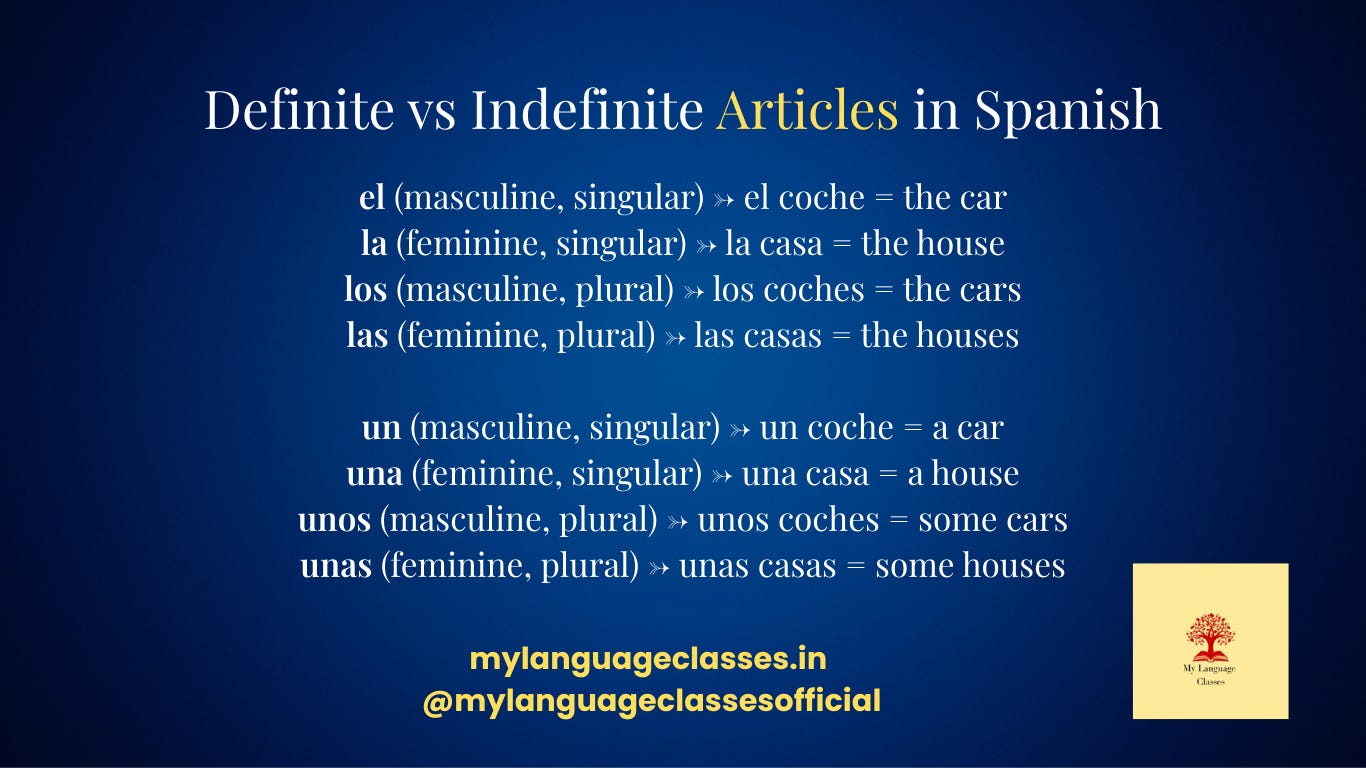
Confused about when to use la casa vs una casa?
You’re not alone. Articles trip up many Spanish learners, especially at the beginning.
The good news? Once you see the clear pattern, articles in Spanish become one of the easiest parts of the language. Let’s break it down step by step—so you’ll never second-guess again.
What Are Articles in Spanish?
Articles are the small words that come before nouns. In English, you already use them all the time:
The car
A book
In Spanish, articles serve the same purpose—but they change based on gender (masculine/feminine) and number (singular/plural).
So instead of just “the” or “a,” you need to match the article to the noun:
El libro = the book (masculine, singular)
La mesa = the table (feminine, singular)
Un perro = a dog (masculine, singular)
Unas casas = some houses (feminine, plural)
👉 Already noticing the pattern? Every noun has a “partner article.”
Quick check: Do you remember if agua (water) is masculine or feminine?
(Hint: it’s feminine, but it takes el agua to avoid double vowels.)
Definite Articles in Spanish: Talking About The
Definite articles point to something specific. Think of them as “the” in English.
There are four forms:
El (masculine, singular)
La (feminine, singular)
Los (masculine, plural)
Las (feminine, plural)
Examples:
El profesor = the teacher (male)
La profesora = the teacher (female)
Los estudiantes = the students (group of males or mixed)
Las estudiantes = the students (all female)
We use definite articles when the speaker and listener both know the thing being talked about.
📌 Imagine this: You’re in a café in Madrid. If you say “Pásame el azúcar” (Pass me the sugar), both you and the waiter know you’re talking about the sugar on the table, not sugar in general.
👉 Micro-question: When you introduce yourself, do you say Soy el Juan? Why or why not?
Indefinite Articles in Spanish: Talking About A / Some
Indefinite articles are for something general, not specific.
There are also four forms:
Un (masculine, singular)
Una (feminine, singular)
Unos (masculine, plural)
Unas (feminine, plural)
Examples:
Un coche = a car (any car, not a specific one)
Una idea = an idea
Unos amigos = some friends
Unas canciones = some songs
📌 Picture this: You’re at a bookstore. If you tell your friend “Quiero comprar un libro” (I want to buy a book), it doesn’t matter which one—it’s just any book.
👉 Micro-question: Do you prefer to read un libro (any book) or el libro (a specific one your friend recommended)?
Key Differences Explained
So how do you know whether to use definite or indefinite articles?
Use definite articles (el, la, los, las) when you are talking about something specific, something the listener can identify.
Use indefinite articles (un, una, unos, unas) when you are talking about something general, one of many, or not yet defined.
👉 Tip for learners: If in English you could say “that exact one,” it’s definite. If you mean “just any one,” it’s indefinite.
Common Learner Mistakes (and How to Fix Them)
Forgetting gender agreement
❌ El casa
✅ La casa
Mixing singular and plural
❌ Las coche
✅ Los coches
Dropping the article too often
In Spanish, you usually need the article where English might skip it.
👉 Micro-question: Have you ever accidentally said un agua instead of el agua?
When to Drop the Article in Spanish
Yes, there are times when Spanish drops the article.
Professions after ser:
Soy profesor. = I am a teacher.
But if you add an adjective, the article comes back: Soy un profesor dedicado. = I am a dedicated teacher.
Languages after aprender, hablar, estudiar—unless you use a preposition:
👉 Voice-search style question: “Do I need the article before a profession in Spanish?” Answer: Only if you add an adjective!
Quick Practice Challenge
Fill in the blanks:
___ libro está en la mesa. (the book)
Quiero ___ café, por favor. (a coffee)
___ amigos vienen esta noche. (some friends)
___ profesora es muy simpática. (the teacher, female)
Answers: 1. El 2. Un 3. Unos 4. La
👉 Which one did you get wrong? Share in the comments!
Final Takeaways
Use definite articles when the noun is specific.
Use indefinite articles when it’s general.
Sometimes Spanish requires the article even if English doesn’t.
❓ Which of these rules surprised you most?
📌 Follow My Spanish Classes for your daily Spanish tip—and never miss a chance to level up your Spanish.
📌Keep learning and growing with us:
Website:
https://mylanguageclasses.in/
LinkedIn Group: https://www.linkedin.com/groups/13365039/
Medium: https://medium.com/@mylanguageclasses
Substack: https://substack.com/@mylanguageclasses
Facebook Group: https://www.facebook.com/share/g/14LKxZChKJp/
Instagram: https://www.instagram.com/mylanguageclassesofficial
WhatsApp Group: https://chat.whatsapp.com/KHuzPfGkRt77vzvFU9TK3F?mode=ac_t
Telegram Channel: https://t.me/mylanguageclasses
YouTube: https://www.youtube.com/@mylanguageclassesofficial
Related Lessons
Sentence Structures and Clauses in Spanish
Expressions and Idioms in Spanish
Books
https://mybook.to/Grammar-for-DELE-A1
https://mybook.to/Stories-1-DELE-A1-A2
https://mybook.to/DELE-A1-Gr-eb-Part-1
https://mybook.to/DELE-A1-Gr-eb-Part-2
https://mybook.to/DELE-A1-Gr-eb-Part-3
https://mybook.to/DELE-A1-Gr-eb-Part-4
https://mybook.to/es-A1-Gr-eb-Part-5
https://mybook.to/spanish-in-30-days
— Team My Language Classes