

Ever wondered how to talk about your daily life in Spanish?
Maybe you want to say “I eat breakfast,” “She studies Spanish,” or “We live in Madrid.”
Here’s the good news: all of these sentences use one of the most important verb forms in the language — the present indicative with regular verbs.
It’s simple once you see the patterns. And once you get it, you can already express hundreds of sentences in Spanish.
So, let’s break it down step by step.
Why the Present Indicative Matters
The present indicative is the first verb tense most learners encounter.
Why? Because it’s the tense we use to talk about habits, daily routines, and facts.
Think about it. When you introduce yourself, you’ll likely say:
Yo estudio español. → “I study Spanish.”
Trabajo en una oficina. → “I work in an office.”
See how useful that is?
Have you noticed how often you use the present tense in English? That’s exactly how Spanish works too.
👉 Question for you: What’s the very first thing you’d like to say in Spanish about your daily life?
The Three Regular Verb Groups in Spanish
Every Spanish verb ends in -ar, -er, or -ir.
That’s the secret to conjugation. Once you learn the endings, you can apply them to hundreds of verbs.
Let’s look at the patterns.
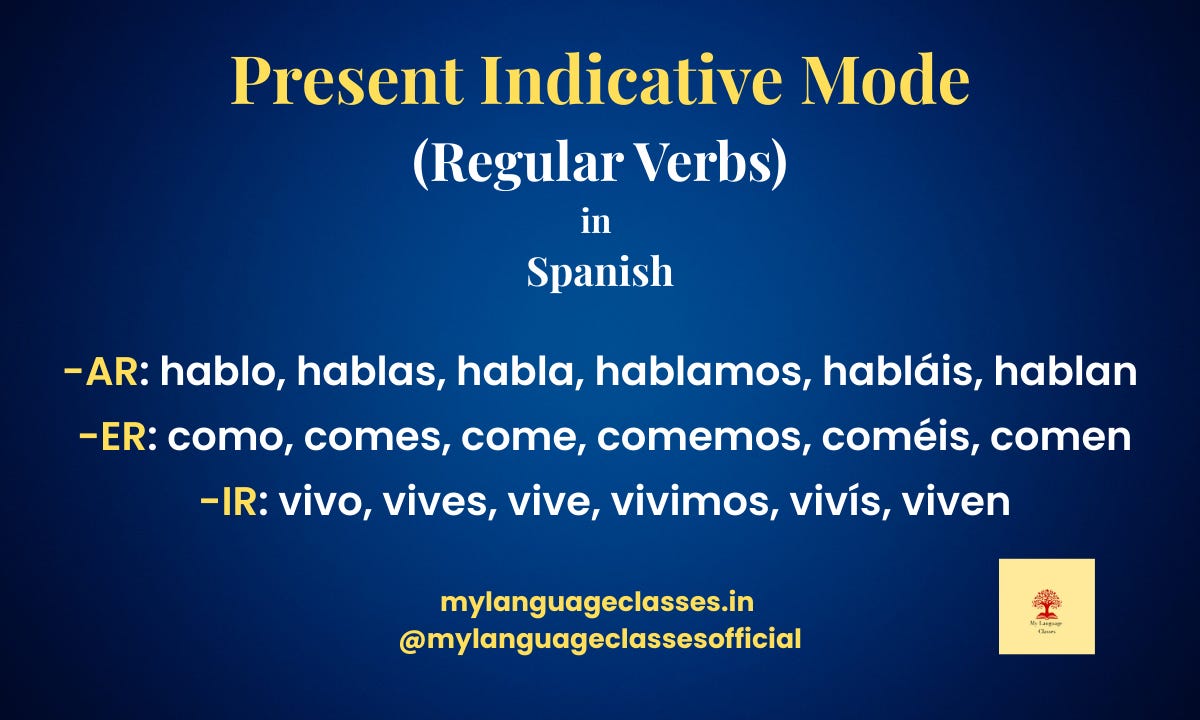
1. -AR Verbs (Hablar – “to speak”)
Yo hablo → I speak
Tú hablas → You speak
Él / Ella habla → He/She speaks
Nosotros hablamos → We speak
Vosotros habláis → You all speak (Spain)
Ellos hablan → They speak
Try this: How would you say “We speak Spanish” in Spanish?
2. -ER Verbs (Comer – “to eat”)
Yo como → I eat
Tú comes → You eat
Él / Ella come → He/She eats
Nosotros comemos → We eat
Vosotros coméis → You all eat (Spain)
Ellos comen → They eat
Notice how the endings are a little different from -ar verbs, but the pattern is just as clear.
👉 Quick check: How do you think you’d say “She eats bread” in Spanish?
3. -IR Verbs (Vivir – “to live”)
Yo vivo → I live
Tú vives → You live
Él / Ella vive → He/She lives
Nosotros vivimos → We live
Vosotros vivís → You all live (Spain)
Ellos viven → They live
This group looks similar to -er verbs but with a twist for “we” and “you all.”
Reflection: Which verb group feels easiest for you so far?
Everyday Scenarios Using Regular Verbs
Learning grammar in isolation can feel dry. So, let’s see how these verbs appear in real life.
Imagine a typical day:
Morning: Desayuno café con leche. → “I eat breakfast with coffee and milk.”
Afternoon: Trabajo en casa. → “I work at home.”
Evening: Vivimos en una ciudad pequeña. → “We live in a small town.”
With just a handful of verbs, you can already describe your whole routine.
👉 Have you tried making a mini Spanish diary of your day?
Common Mistakes Learners Make
Even though the present indicative is simple, learners often fall into these traps:
Forgetting subject pronouns
In Spanish, you don’t always need to say yo or tú. The verb ending already shows who is doing the action.
Example: Como pan. → “I eat bread.” (No need to say yo.)Mixing up verb endings
Beginners sometimes apply -ar endings to -er verbs.
Example: Saying yo comas instead of yo como.Translating too literally from English
Not every English present tense sentence translates directly. For example:
“I am eating” can be Estoy comiendo (present progressive), not Como (present simple).
👉 Which of these mistakes do you catch yourself making?
Quick Practice: Build Your Own Sentences
Try these three steps to test yourself right now:
Pick a verb ending (-ar, -er, or -ir).
Conjugate it in the “yo” form.
Add an object or complement.
Examples:
Yo estudio español. → “I study Spanish.”
Yo como fruta. → “I eat fruit.”
Yo vivo en México. → “I live in Mexico.”
Now, create three of your own. Post them in the comments — let’s learn together!
Tips to Master Regular Verbs Faster
Repetition matters. Read and say the verbs aloud every day.
Use flashcards. Keep verbs in one color and endings in another.
Practice with your life. Conjugate verbs to describe what you actually do.
Record yourself. Hearing your own Spanish helps lock it in.
👉 What’s your favorite way to memorize verbs?
Takeaway
The present indicative with regular verbs is your doorway to real Spanish communication.
Once you can use hablar, comer, vivir, and other regular verbs, you’re no longer memorizing lists — you’re actually speaking.
So here’s your challenge: write three sentences tonight about your own day using regular verbs.
❓ Which of these examples surprised you most?
📌 Follow My Language Classes for your daily Spanish tip — and start using Spanish in real life today.
📌Keep learning and growing with us:
Website:
https://mylanguageclasses.in/
LinkedIn Group: https://www.linkedin.com/groups/13365039/
Medium: https://medium.com/@mylanguageclasses
Substack: https://substack.com/@mylanguageclasses
Facebook Group: https://www.facebook.com/share/g/14LKxZChKJp/
Instagram: https://www.instagram.com/mylanguageclassesofficial
WhatsApp Group: https://chat.whatsapp.com/KHuzPfGkRt77vzvFU9TK3F?mode=ac_t
Telegram Channel: https://t.me/mylanguageclasses
YouTube: https://www.youtube.com/@mylanguageclassesofficial
Related Lessons
Sentence Structures and Clauses in Spanish
Expressions and Idioms in Spanish
Books
https://mybook.to/Grammar-for-DELE-A1
https://mybook.to/Stories-1-DELE-A1-A2
https://mybook.to/DELE-A1-Gr-eb-Part-1
https://mybook.to/DELE-A1-Gr-eb-Part-2
https://mybook.to/DELE-A1-Gr-eb-Part-3
https://mybook.to/DELE-A1-Gr-eb-Part-4
https://mybook.to/es-A1-Gr-eb-Part-5
https://mybook.to/spanish-in-30-days
— Team My Language Classes