

If you’re learning Spanish, one of the biggest challenges you’ll face is understanding when to use ser and when to use estar. Both verbs translate to “to be” in English, but in Spanish, they carry very different meanings depending on the context.
Mastering ser vs estar is essential for sounding natural and accurate in Spanish conversations. In this article, we’ll explore the key differences between ser and estar, give you practical examples, and provide tips to avoid common mistakes.
Whether you’re a beginner or an intermediate learner, this guide will help you finally feel confident when using these two tricky verbs.
What Are Ser and Estar?
The Spanish verbs ser and estar both mean to be, but they serve distinct purposes.
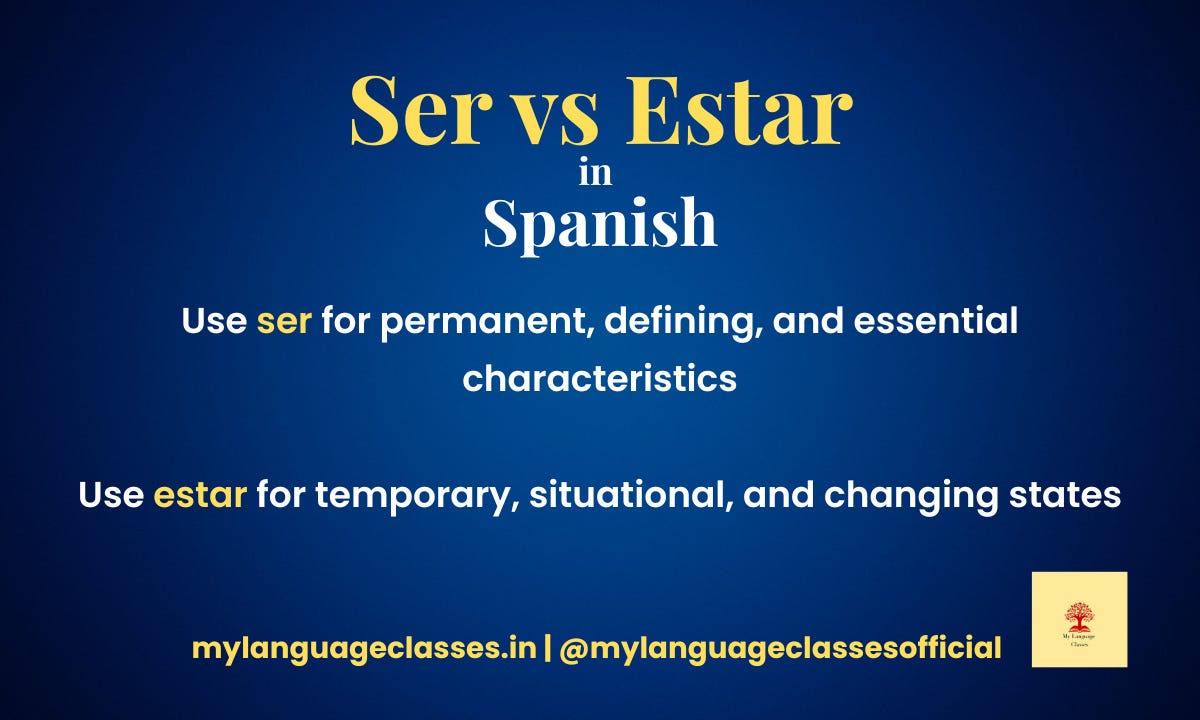
Ser is used to describe essential characteristics that do not change easily.
Estar is used to describe temporary states or conditions that can change.
👉 Think of ser as describing what something is and estar as describing how something is.
For example:
Ella es médica. → She is a doctor. (identity, permanent)
Ella está cansada. → She is tired. (temporary condition)
This difference is at the heart of understanding ser vs estar in Spanish.
Ser: The Verb for Permanent or Defining Qualities
When learning Spanish, you’ll use ser to talk about inherent, unchanging, or defining qualities. These are aspects of a person, place, or thing that are considered stable.
Common Uses of Ser
Use ser for:
Identity and professions → Soy profesor. (I am a teacher.)
Origin and nationality → Somos de México. (We are from Mexico.)
Characteristics and descriptions → La casa es grande. (The house is big.)
Time and dates → Hoy es lunes. (Today is Monday.)
Possession → Ese libro es mío. (That book is mine.)
Events/locations of events → La reunión es en la oficina. (The meeting is in the office.)
👉 Quick tip: If the information defines or classifies someone or something, use ser.
Estar: The Verb for Temporary States and Locations
On the other hand, estar is used for conditions that are changeable or tied to the present moment. It’s the verb of “state” and “location.”
Common Uses of Estar
Use estar for:
Emotions and feelings → Estoy feliz. (I am happy.)
Physical conditions → El café está frío. (The coffee is cold.)
Locations of people or things → El libro está en la mesa. (The book is on the table.)
Ongoing actions (progressive tense) → Estamos estudiando. (We are studying.)
Temporary results of actions → La puerta está cerrada. (The door is closed.)
👉 Quick tip: If it’s how you feel or where you are, then use estar.
Ser vs Estar: Key Differences Summarized
The main difference comes down to permanence vs. temporariness.
Ser = Permanent, defining, essential
Estar = Temporary, changeable, situational
Examples side by side:
El cielo es azul. (The sky is blue. → general truth, permanent)
El cielo está gris. (The sky is gray. → temporary condition)
Ser vs Estar with Adjectives: A Subtle but Important Difference
Many Spanish adjectives change meaning depending on whether you use ser or estar. This is where learners often get confused.
Él es aburrido. → He is boring.
Él está aburrido. → He is bored.
María es lista. → María is clever/smart.
María está lista. → María is ready.
👉 Notice how the same adjective takes on a new meaning depending on whether it describes an essential quality (ser) or a temporary state (estar).
Common Mistakes Learners Make with Ser and Estar
Even advanced Spanish learners sometimes mix these verbs up. Here are the most common mistakes and how to fix them:
❌ Estoy profesora. → Incorrect
✅ Soy profesora. (Because profession = identity)❌ Soy cansado. → Incorrect
✅ Estoy cansado. (Because tired = temporary state)❌ La fiesta está en la oficina. → Incorrect
✅ La fiesta es en la oficina. (Events use ser)
👉 Pay close attention to whether the sentence is about definition or condition.
How to Practice Ser and Estar in Real Life
To really master ser vs estar, practice is key. Here are some strategies:
Create comparison sentences: Write two sentences with the same adjective, one with ser and one with estar.
Describe your day: Use estar for how you feel and ser for who you are or what you do.
Listen to native speakers: Notice how they naturally choose between ser and estar.
Practice with flashcards: Put one verb on each side with example sentences.
Mini Exercises: Test Yourself
Try to complete these with ser or estar:
Yo ___ feliz hoy.
Nosotros ___ estudiantes de español.
El libro ___ en la mesa.
Madrid ___ la capital de España.
Tú ___ cansado después del trabajo.
Answers:
estoy → (temporary feeling)
somos → (identity/profession)
está → (location)
es → (fact, permanent)
estás → (temporary condition)
Why Ser vs Estar Matters in Learning Spanish
Mastering ser and estar will unlock a deeper level of fluency in Spanish. It helps you:
Express yourself more naturally
Avoid common misunderstandings
Gain confidence in speaking and writing
Sound more like a native speaker
👉 Learning Spanish isn’t just about memorizing grammar rules—it’s about using them in real communication.
Key Takeaways
Ser = permanent, essential, defining qualities.
Estar = temporary, situational, emotional, or locational states.
Many adjectives change meaning depending on which verb you use.
Practice by creating real-life examples and noticing patterns in native speech.
Final Thoughts
The difference between ser vs estar is one of the most important grammar points in Spanish. At first, it may feel confusing, but with regular practice, you’ll start to think in Spanish and know instinctively which verb to use.
If you found this article helpful, share it with other learners and leave a comment below—what’s the hardest part about mastering ser and estar for you?
👉 For more detailed Spanish grammar guides, real-life examples, and language learning tips, subscribe to My Spanish Classes on Substack. Join our growing community of passionate learners and take your Spanish to the next level.
📌Keep learning and growing with us:
Website:
https://mylanguageclasses.in/
LinkedIn Group: https://www.linkedin.com/groups/13365039/
Medium: https://medium.com/@mylanguageclasses
Substack: https://substack.com/@mylanguageclasses
Facebook Group: https://www.facebook.com/share/g/14LKxZChKJp/
Instagram: https://www.instagram.com/mylanguageclassesofficial
WhatsApp Group: https://chat.whatsapp.com/KHuzPfGkRt77vzvFU9TK3F?mode=ac_t
Telegram Channel: https://t.me/mylanguageclasses
YouTube: https://www.youtube.com/@mylanguageclassesofficial
Related Lessons
Sentence Structures and Clauses in Spanish
Expressions and Idioms in Spanish
Books
https://mybook.to/Grammar-for-DELE-A1
https://mybook.to/Stories-1-DELE-A1-A2
https://mybook.to/DELE-A1-Gr-eb-Part-1
https://mybook.to/DELE-A1-Gr-eb-Part-2
https://mybook.to/DELE-A1-Gr-eb-Part-3
https://mybook.to/DELE-A1-Gr-eb-Part-4
https://mybook.to/es-A1-Gr-eb-Part-5
https://mybook.to/spanish-in-30-days
— Team My Language Classes